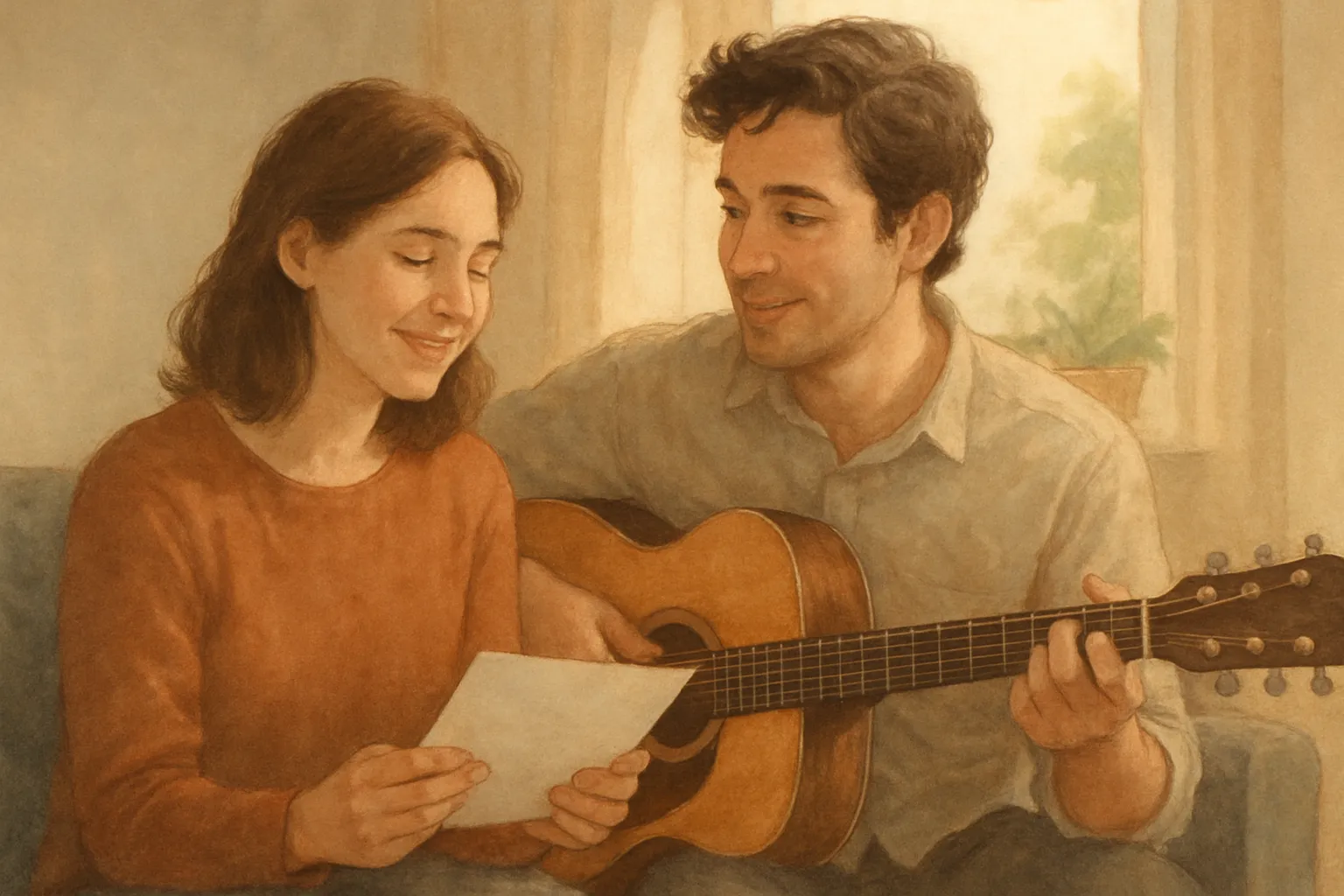
can you make a song from a story?
By Mara Vidal — Songwriter on the Songive team
Updated 8 min readGuides
Yes. A story is the best possible starting point — better than a mood, a genre, or a list of adjectives. Give us the plain facts of what happened, and we turn them into a song with the person's name in it.
Listen to this article
Yes, you can make a song from a story, and honestly it's the easiest brief we get. Hand us a short account of something that happened — the night you met, the move across the country, the thing your dad always says — and we shape it into a finished song. You don't write a single line of verse. You just tell us what happened.
What making a song from a story means: you send a few honest paragraphs about a real person or moment, and you get back a complete song — lyrics, melody, the whole thing — that puts that story to music. The narrative is the raw material; the craft is turning it into something you can play.
What actually happens when a story lands on our desk
We read it twice. First for the facts, then for the feeling. Somewhere in most stories there's a single line that carries the whole thing — a phrase, a small detail, the bit that makes you go quiet. That becomes the hook. Everything else arranges itself around it.
Take the birthday demo above. A daughter sent us three short paragraphs about her mum — nothing polished, just how she'd wait up with the porch light on, how she never learned to sit still, how she'd started painting again at sixty. We didn't use all of it. We used the porch light. One image, repeated, and the rest of the song leaned on it. That's the job: not fitting everything in, but finding the one thing that everything else can hang from.
Do you need to be a good writer to do this?
No. In fact the plainer the story, the better it usually works. We'd rather have four honest sentences than a page of adjectives.
The stories that give us the most to work with tend to read like someone telling a friend what happened. "He proposed on the last morning of the trip, in the rain, and neither of us had an umbrella." That's a whole verse right there — the setting, the weather, the small human detail. You don't need to make it sound like a song. Making it sound like a song is our part.
What trips people up is going abstract. "She's my rock, she's always there for me" gives us nothing to hold. "She drove three hours in the middle of the night when the car broke down on the M6" gives us everything. Specific beats poetic, every time.
How you turn a story into a finished song, step by step
Here's the whole thing from your side. It's shorter than you'd think.
You write the story down. A few paragraphs, plain language, in the box on our song brief page. Tell us who it's for, what happened, and one or two things only you'd know. You pick a mood — warm, upbeat, tender — and a rough style if you have a preference. If you don't, we choose one that fits the tone of what you wrote.
You get the lyrics. We turn your story into verses and a chorus, keeping the true details and shaping the rest. You read them over. If the name's spelled differently or we've leaned on the wrong moment, you tell us and we adjust. Nothing gets sung until the words feel right to you.
You get the finished song. The complete track arrives in about two minutes — sung, arranged, done. Their name in the chorus if you asked for it. You download it, and you decide when and how to hand it over.
That's it. No studio, no waiting weeks, no learning to read music.
What makes a story-based song better than the alternatives
Most ways of marking an occasion don't touch the actual story. A playlist gathers songs about love in general. A cover of a favourite track is someone else's story sung well. A handwritten note holds the story but can't be played on a speaker at a party. Here's how the common options compare when what you have is a story worth telling.
| Option | Uses your actual story | Their name in it | Ready in ~2 minutes | Languages |
|---|---|---|---|---|
| Songive | Yes — it's the source | Yes | Yes | Many |
| Songfinch | Partly, via a brief | Sometimes | No — days to weeks | English-led |
| Suno (DIY) | Only if you write the lyrics yourself | If you manage it | Yes | Several |
| A cover of their favourite song | No | No | No | As recorded |
| A handwritten letter | Yes | Yes | Yes | Yours |
A letter and a story-song do different jobs. Give the letter too, if you like. But the song is the version that plays out loud, that they can put on again a year later. See our fuller take on a personalized song versus a cover song if you're weighing those two.
What to put in the box so the story sings
When you're writing it down, four things do most of the lifting.
The moment, not the summary. Instead of "we've been through a lot together," give us the actual scene. "We shared one umbrella walking back from her graduation in Leeds and both got soaked laughing." A scene has weather, place, and people in it — a summary has none.
One thing only you'd know. The nickname his gran gave him, the song that was playing when the twins were born, the way she says "right then" before she starts a job. These small private things are what make the recipient realise the song is truly theirs.
How it should feel. Tell us if this is a gentle one or a room-filling one. "He'll pretend he's not moved but he will be" tells us more about the register than any genre label could.
The name and how it's said. Give us the spelling you want sung and whether it's a full name, a shortening, or a pet name. "Everyone calls him Wes, never Wesley" is exactly the kind of note that keeps the chorus honest.
FAQ
Can you make a song from a story I write?▾
Yes. A written story is the ideal starting point — you send a few honest paragraphs about the person or the moment, and we turn them into a complete song. You don't write any lyrics yourself; the narrative is the raw material and the songwriting is our part.
How long does the story need to be?▾
A few short paragraphs is plenty, and shorter is often better. Four honest sentences with a real detail in them give us more to work with than a full page of general praise. We'd rather have the porch light than a list of adjectives.
What kind of story works best in a song?▾
The specific kind. A real scene with a place, a moment, and one thing only you'd know beats anything abstract. "She drove three hours in the night when the car broke down" works far better than "she's always there for me."
Can I change the lyrics before it becomes a song?▾
Yes. You see the words first and can adjust them — a name spelled differently, a detail we leaned on that wasn't quite right. Nothing is sung until the lyrics feel true to you and your story.
How fast do I get the finished song?▾
The complete track arrives in about two minutes once the lyrics are settled. That's the full song — sung, arranged, and ready to download — so a story you jotted down today can be a finished song the same evening.