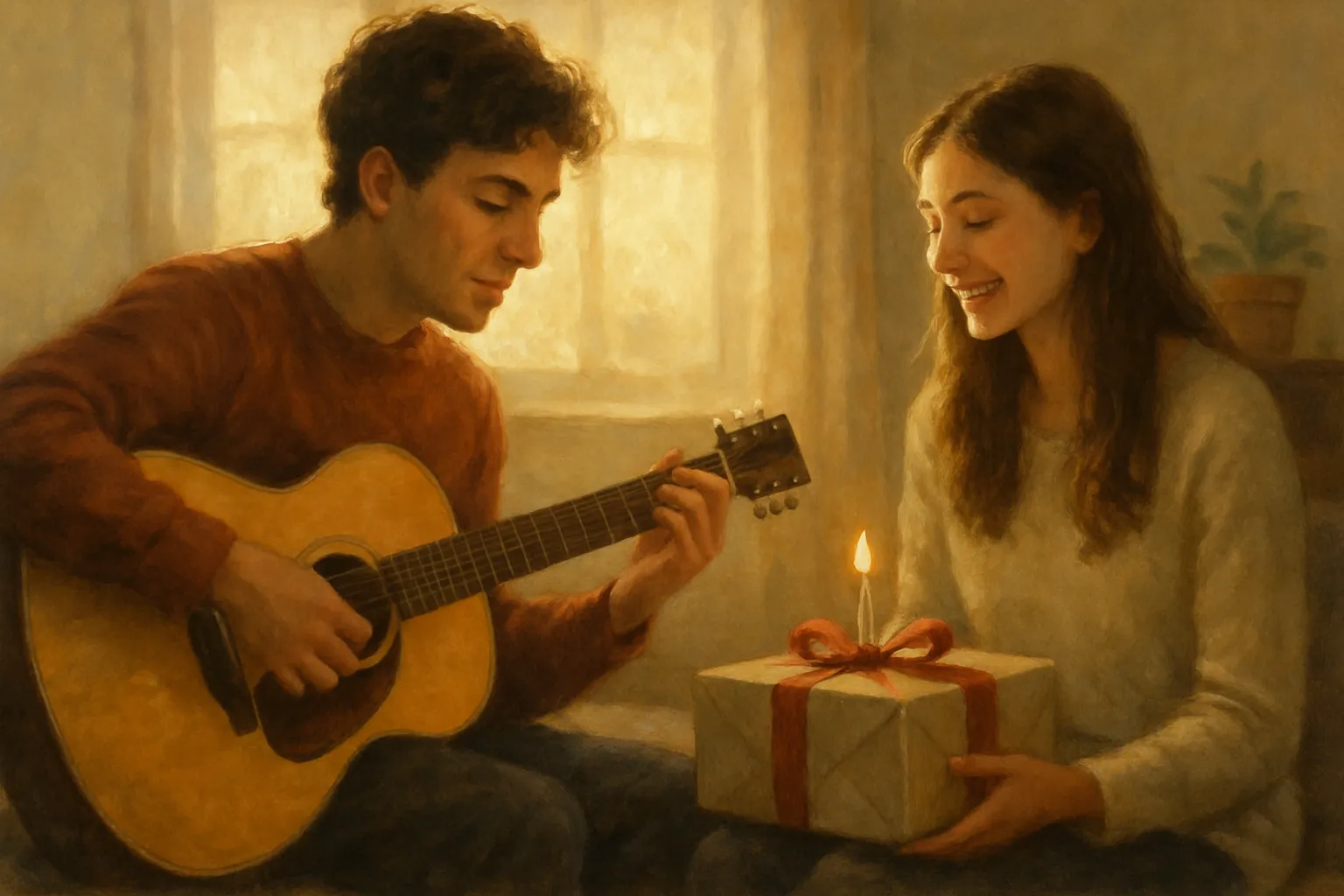
how to make a birthday song special
By Daniel Brooks — Songwriter on the Songive team
Updated 8 min readGuides
A birthday song feels special when it names the person and a moment only they would recognise. Not "happy birthday to you" on repeat — the year they moved cities, the way they answer the phone. Here is how we make one land.
Listen to this article
To make a birthday song special, name one true thing about the person and build the song around it. Their name goes in the chorus. A real moment — the year they finally learned to drive, the way they always arrive twenty minutes early — carries the verses. Skip the generic wishes. A song about a specific person beats a song about "a birthday" every time.
What a special birthday song is: a short, made-to-order song written for one person, using their name and details from their actual life, delivered as a finished track they can play on their phone or over speakers on the day.
We write a lot of these on the Songive team. The birthday ones are the most common brief that lands on our desk, and they are also the easiest to get wrong. Most people default to sweet, safe and vague. Below is how we actually approach them, and what we notice separates the songs that get replayed from the ones that get one polite listen.
What makes a birthday song feel personal rather than generic?
A birthday song feels personal when it could only have been written for that one person. That is the whole test. If you could swap the name out and hand the song to someone else, it isn't there yet.
Generic songs lean on birthdays as a category — cake, candles, another year older, wishes for the future. None of that belongs to anyone. The special ones lean on a person. Here is the difference in practice:
- Generic: "Happy birthday, hope your dreams come true." It's warm and it's nothing.
- Personal: "Forty and you still can't parallel park, but you'd drive three hours to help anyone move." That's a person.
We'd rather have one odd, true detail than ten polished compliments. The name in the chorus is what makes people sit up; the detail in the verse is what makes them go quiet.
The steps we actually follow
From your side it's quick. You don't write the song — you hand us the raw material and pick a sound. Here's the whole thing.
Step one — write a short brief about them
You tell us who the song is for and give us a handful of true things. Not a life story. Three or four details do more work than a page of them. A good one might read: "For my sister Priya, turning thirty. She moved to Manchester last year and hates that everyone said she wouldn't cope. She sends voice notes that are four minutes long. We call her the family's unofficial GP." That's plenty. You can add it at the create page in a few lines.
Step two — you get the lyrics
We turn the brief into a set of lyrics with her name in the chorus and those details woven through the verses. You read them before anything is sung. If the voice notes line should be funnier, or the Manchester line should stay in, you say so. Nothing is finished until the words sound like the person you described, not a stranger with the same name.
Step three — you get the finished song
You pick a genre — acoustic, pop, something upbeat, a slow ballad — and you get back a complete track, usually in about two minutes. Not a demo, not a sketch. A song you can text her, play at the dinner, or drop into a group chat the night before. If the mood is off you can adjust and get another version.
What we notice makes birthday songs land
After a lot of these, a few patterns hold up. Specific beats sweeping. A single true moment — the time they got lost in Edinburgh, the nickname their nan gave them — will always outperform "you're the best person I know." People cry at the small stuff, not the grand stuff.
Match the genre to them, not to you. A gentle acoustic ballad is a lovely default, but if the birthday person plays terrible dance music in the kitchen, an upbeat track will feel more like them. The birthday-1 song below is a good example — it started from a daughter's short note about her dad, kept it warm and playful rather than solemn, and it fits him because he isn't a solemn man.
Length matters less than you'd think. Two verses and a chorus that actually says something beats a five-minute track that runs out of real material after the first minute. If you're comparing your options, we walk through the trade-offs in personalized song versus a cover song.
How does a made-to-order song compare to the usual birthday options?
A made-to-order song is the only option on this list that uses the person's actual name and life. Everything else is borrowed. Here's how the common choices stack up.
| Option | Uses their name | Speed | Made for one person |
|---|---|---|---|
| Songive | Yes, in the chorus | About two minutes | Yes, from your brief |
| Songfinch | Yes | Days to weeks | Yes, human songwriter |
| Suno | Only if you write the lyrics yourself | Minutes | You do the personalising |
| A birthday playlist | No | Instant | No — borrowed songs |
| A handwritten card | You write the name | An evening | Yes, but silent |
A playlist is thoughtful and completely impersonal — none of those songs know the person. A handwritten card is personal but it doesn't play at the party. Songfinch pairs you with a songwriter and takes longer, which is fine if you've planned ahead. Songive gives you the name-in-the-chorus outcome fast enough to still work the night before. For a wider look, see our birthday song gift guide.
What to put in the box about them
The brief is where the song is won or lost. Four things do most of the heavy lifting.
A moment only the two of you would know. Not "we're close" — "you queued two hours in the rain for my graduation and pretended you didn't mind." The oddly specific memory is the one that makes them look up mid-song.
How they talk or move. The phrase they overuse, the way they laugh, the fact they narrate every recipe out loud. These are the fingerprints that make a lyric unmistakably them rather than a generic loved one.
The tone you want. Tell us if this should be funny, tender, or a bit of both. A song roasting your best mate's terrible parking needs a different register from a quiet one for a grandparent, and knowing which saves a round of edits.
What you'd never say out loud. The thing you feel but skip past on the phone — that they held the family together, that you're proud of them. The song can say it for you, which is often the entire point of giving one.
FAQ
How do I make a birthday song feel special instead of generic?▾
Build it around one true thing about the person rather than birthdays in general. Use their name in the chorus and put a real moment — a specific memory, a habit, a nickname — in the verses. If you could hand the same song to someone else, it isn't personal enough yet.
What details should I include for the best result?▾
A specific memory, the way they talk or move, the tone you want, and the thing you'd never say out loud. Three or four true details beat a long biography, because a song has room for a few things done well, not everything at once.
How long does it take to get a birthday song?▾
You usually get a finished track in about two minutes after you write the brief and pick a genre. That's fast enough to sort a gift the night before a birthday, though you can also adjust the mood and get another version if the first isn't quite right.
Can I choose the style of the song?▾
Yes — you pick the genre, from acoustic and pop to something upbeat or a slow ballad. The trick is to match the sound to the birthday person rather than to your own taste, so a song for someone who loves loud kitchen dancing lands better upbeat than solemn.
Is a made-to-order song better than a birthday playlist?▾
A playlist is thoughtful but impersonal, because none of those songs know the person. A made-to-order song uses their actual name and life, so it says something a borrowed track never can. It's the difference between choosing songs about birthdays and having one written about them.