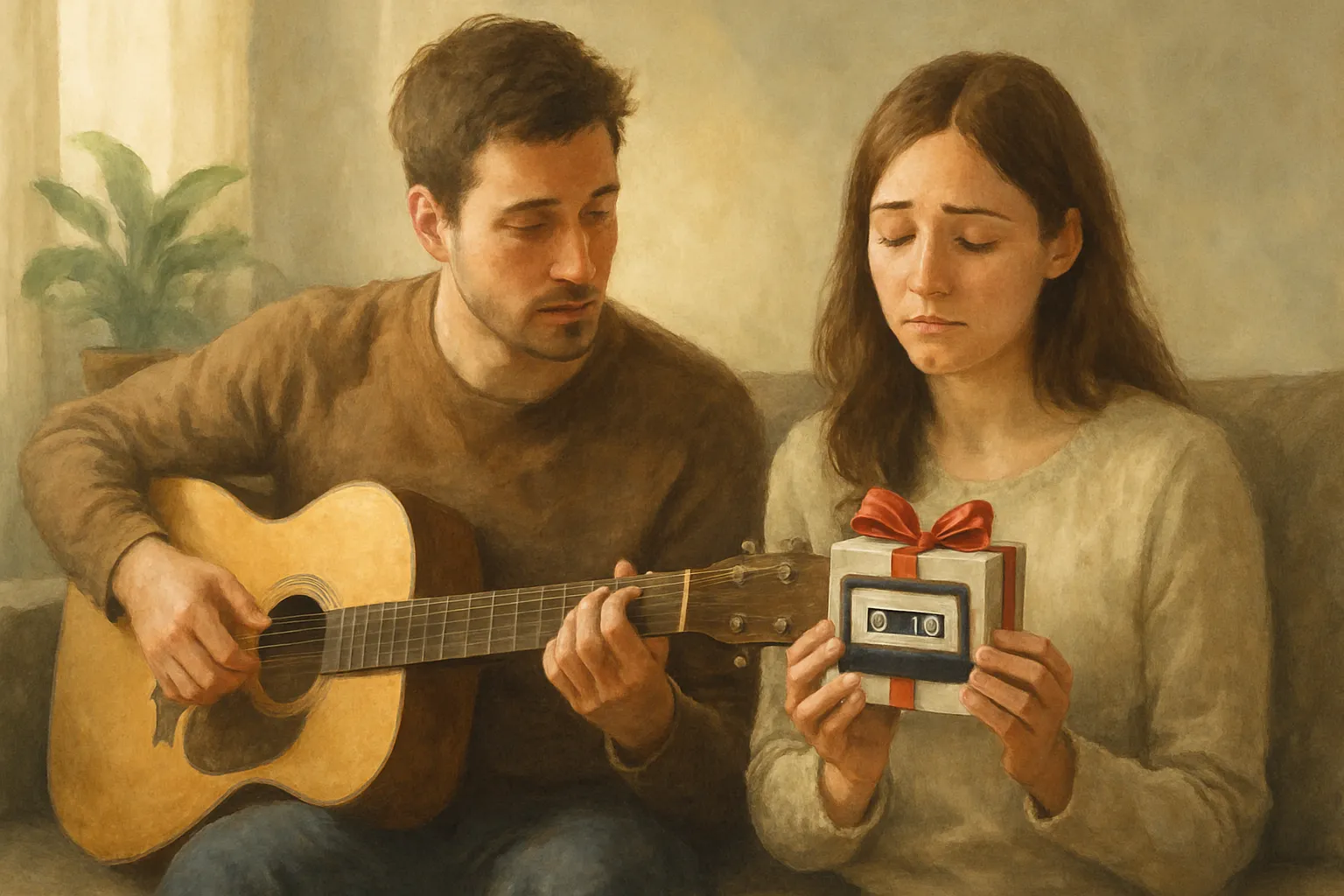
personalized song gift mistakes that make the song fall flat
By Mara Vidal — Songwriter on the Songive team.
Updated 8 min readGuides
Most personalized songs that miss the mark fail for the same handful of reasons. Almost all of them trace back to the brief, not the song. Fix the brief and the song lands.
Listen to this article
Personalized song gift mistakes are the small choices that flatten a custom song — a brief stuffed with adjectives instead of moments, too many names crammed into one chorus, or a tone that fights the occasion. Almost every flat song we have seen traces back to the brief, not the music. Get the brief right and the song carries itself.
What a personalized song gift is: a song written from scratch about one specific person, with their name, their story and the right mood, sent to them as a finished track. Songive makes it from a short brief you write, usually back in your hands in about two minutes.
We have made a lot of these now, and the ones that don't land tend to fail in predictable ways. Here is what goes wrong, and the fix for each.
Mistake one: the brief is all adjectives, no moments
The most common way a song falls flat is a brief that lists qualities instead of memories. "She's kind, funny, hardworking, loyal, the best mum anyone could ask for." That tells us nothing a stranger couldn't guess. A song built on those words sounds like a greeting card read aloud.
What works instead is one true thing that happened. The way she always burns the toast and blames the toaster. The Sunday she drove four hours to pick you up from a station because your train was cancelled. The birthday demo below started from three lines a daughter sent us — none of them adjectives, all of them small scenes — and that is exactly why it lands.
If you want a sense of what a strong brief looks like before you write yours, our note on the difference between weak and strong wording is the place to start.
Mistake two: too many people in one song
A song is not a group card. When a brief tries to honour Mum, Dad, both grandparents and the dog, the chorus has nowhere to stand. Every name dilutes the next. By the end nobody feels truly sung about.
The fix is brutal and simple: pick one person. If it is genuinely a song for a couple — a wedding, a fortieth anniversary — that is two, and it works because they are a unit. Beyond that, you are writing a list, and lists don't move anyone. Save the others for their own songs.
Mistake three: the tone fights the occasion
We have been handed funny, roast-style briefs for a memorial, and tearjerker briefs for a stag do. The words can be lovely and still land wrong because the mood doesn't match the room.
Think about where the song gets played. A retirement do at the pub wants warmth with a wink. A song for someone going through chemo wants steadiness, not jokes about their dodgy knees. Tell us the setting and the feeling you want people to leave with, and we'll pitch the tone to match rather than guess.
Mistake four: leaving out the name and the nicknames
A personalized song that never says the person's name is just a nice song. The name in the chorus is the moment their face changes. Skipping it — or only using a formal version nobody actually calls them — is a quiet way to flatten the whole thing.
If his nan has called him "our Danny" his whole life, that belongs in the song far more than "Daniel." Give us what people actually say out loud at the dinner table.
Mistake five: chasing perfect words instead of true ones
People freeze trying to sound poetic. They write "your unwavering devotion through life's tempests" when they mean "you never once let me down, even the year everything went wrong." The plain version always wins.
You don't need to write well. You need to tell us the truth in your own voice. We do the shaping. The brief is raw material, not a finished verse — the more ordinary and honest it sounds, the better the song reads.
How a song avoids these traps, from your side
The whole point of how Songive works is that you only handle the part you know — the person — and never the music.
- You write a short brief. A few sentences about one person: their name, what they're like through one or two real moments, the occasion, the mood. Five honest lines beat five polished ones.
- You get the lyrics. You read them back and see the moments you sent turned into verses with their name in the chorus. If something is off, you say so and adjust.
- You get the finished song. Usually about two minutes later you have a track you can send, play at the do, or keep. You can request a different feel if the mood isn't quite right.
How the song stacks up against the easy options
When a song lands flat, people reach for a fallback. It is worth seeing why each fallback has its own failure mode before you decide.
A generic Spotify playlist costs nothing and says nothing personal. A cover version of "their song" is lovely but it is still someone else's words about someone else's life. A handwritten letter is deeply personal but can't be played in a room full of people. A do-it-yourself song tool gives you control but also gives you the whole job — and the flat-song mistakes above are exactly the ones it leaves you to make alone. Songive's row below is about the outcome: their name sung back to them, the right mood, ready fast.
| Option | Built around one person | Plays to a room | How fast | Common failure |
|---|---|---|---|---|
| Songive | Yes — name in the chorus | Yes | ~2 minutes | Weak brief, fixable |
| Cover of "their song" | No — someone else's lyrics | Yes | Varies | Not actually about them |
| Spotify playlist | No | Yes | Instant | Feels effortless, in a bad way |
| Handwritten letter | Yes | No | Hours | Can't be shared aloud |
| DIY song tool | Depends on you | Yes | Varies | All the brief mistakes, on you |
If you are weighing the song against a cover specifically, we lay that out in full in personalized song versus cover song.
What to put in the about-them box
The box is where the song is won or lost. Four things to put in it.
- One real scene, told plainly. Not "she's generous" but "she gave her coat to a stranger at the bus stop and walked home freezing." A scene gives the song somewhere to go that a quality never does.
- What people actually call them. The nickname, the family name, the thing shouted across the kitchen. "Our Danny," not "Daniel." That word, in the chorus, is the part they'll replay.
- The occasion and where it'll be played. A fortieth at the pub, a leaving do at the office, a quiet morning at home. Tell us the room and we'll set the mood to suit it instead of guessing.
- A phrase only they say. The thing they always come out with — "right, I'm putting the kettle on," "go on then." Drop one in and the song stops sounding generic the instant they hear it.
For more on choosing the right moment to give one, our guide to the best occasions for a personalized song covers the ones that tend to land hardest.
FAQ
Why did my personalized song feel generic?▾
Almost always because the brief described qualities instead of moments. A song built on "kind and funny" has nothing specific to hold onto. Swap one adjective for one true thing that happened and the same song lands completely differently.
Can I include more than one person in the song?▾
You can, but it usually weakens it. One person, or a couple as a unit, gives the chorus somewhere to stand. Once you add a third and fourth name it becomes a list, and lists don't move anyone — give the others their own songs.
What if the tone of the finished song feels wrong?▾
You can request a different feel and we'll adjust it. The most reliable fix is telling us upfront where the song will be played and the mood you want people to leave with, so we pitch the tone to the room rather than guessing.
Do I need to be good at writing to get a good song?▾
No. Plain, honest sentences in your own voice beat polished poetry every time. You handle the truth about the person; the shaping into verses and chorus is our job. Five ordinary lines are better material than five clever ones.
How long does a personalized song take?▾
Usually about two minutes from a finished brief to a track you can send. The slow part is yours — deciding which one person and which real moment to write about — and that is the part worth taking your time over.