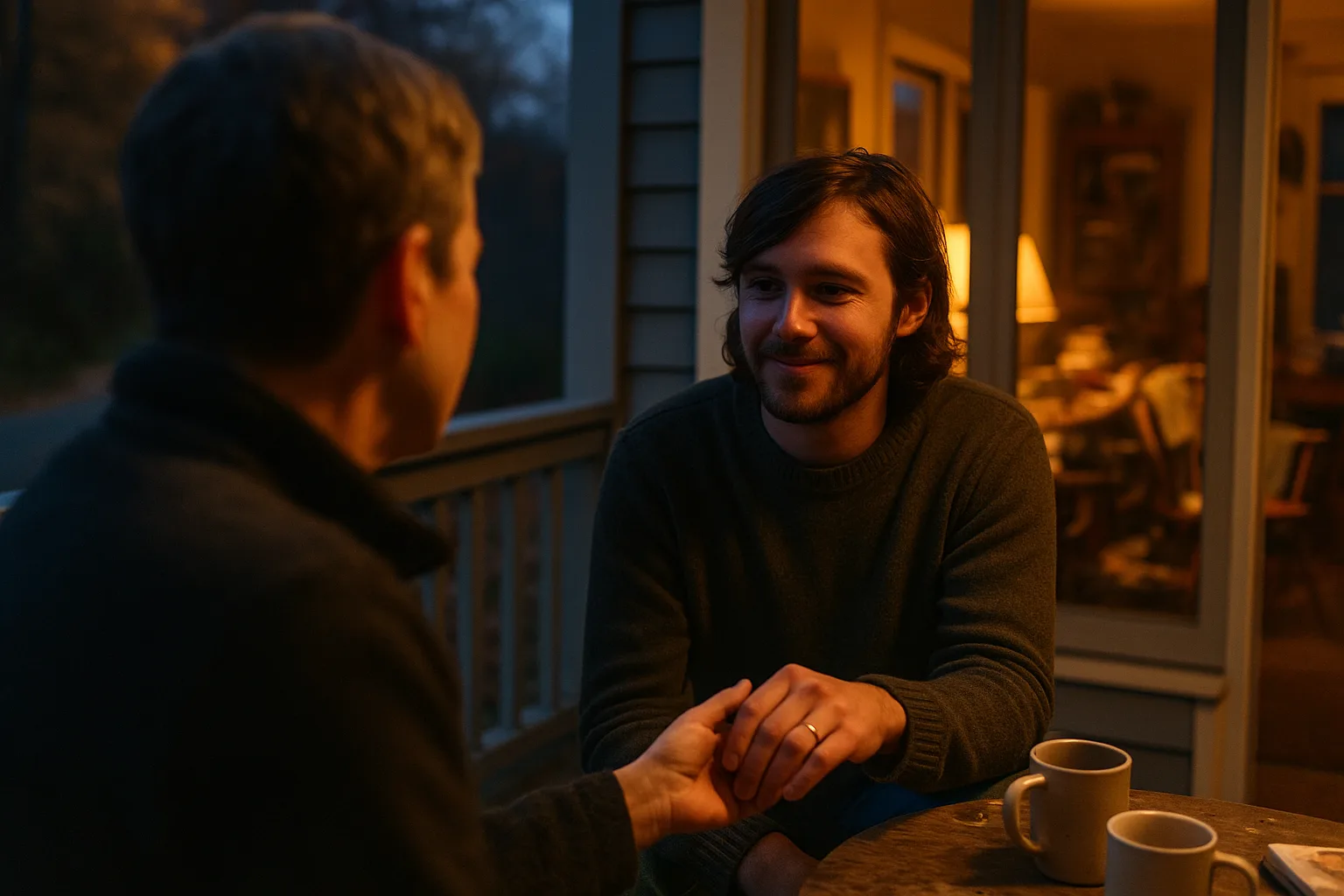
A Diwali gift for parents from daughter, when you can't be home
By Daniel Brooks — Songwriter on the Songive team.
Updated 8 min readOccasions
If you're a daughter watching Diwali from Leicester, Jersey City or Toronto while your parents light the diyas without you, a song is the gift that crosses the distance. It carries their names the way the family says them and a line in your mother tongue, and it lands before the evening puja.
Listen to this article
A Diwali gift for parents from a daughter who lives abroad is a short, personal song that reaches them before the evening puja, built around their names and one Diwali they shared with you. It won't put you in the room for the aarti. What it does is let your voice be heard on the day you most want to be home and aren't.
What it is: a made-to-order song, usually under two minutes, written from a few lines you send about your parents. You can ask for a line in Hindi, Gujarati or Punjabi, and it arrives as a finished track you can play down a video call or send straight to their phone.
I'm a songwriter on the Songive team, and every autumn the same request lands on my desk from daughters in the UK, the US and Canada. The house back home is being scrubbed top to bottom, the diyas are lined up on the windowsill, and the mother on the phone is saying, as she always does, not to send anything. We treat that as the brief, not the refusal.
Why a song, and not another mithai box?
Because the sweets arrive at the door, and a song arrives in their voice memory. You can order a box from the local sweet shop and have it couriered. It's lovely, and it's also what everyone sends. A song does the one thing distance takes away: it speaks.
Here are the moments daughters most often write to us about.
- The first Diwali you spent away from home. You're on a study-abroad year or your first job in a new city, the flat smells of nothing, and the puja is happening six hours behind you. A song that names your parents and the Diwali you cooked in the family kitchen gives them something to play when the call ends.
- The year the flights didn't work out. You meant to be there. Term dates, a shift you couldn't swap, a visa appointment — and suddenly it's the week of Diwali and you're not on a plane. A song you send that morning says what the empty seat at the table can't.
- For a mother who refuses every gift. She tells you off for spending, returns the saree, insists she needs nothing. A song costs her nothing to accept and she can't send it back.
- For a father who doesn't say much. He's the one lighting the diyas in silence while everyone else talks. A song that remembers him sweeping the front step at dawn reaches him in a way a card never has.
- The first Diwali after a loss. The house is quieter this year. A gentle song that holds a grandparent's name alongside your parents' lets the grief sit in the room without anyone having to start that conversation out loud.
- Grandparents watching from the ancestral town. Your parents are abroad with you, and their parents are back in India doing the puja alone. A song in the dialect the elders actually speak travels further than a WhatsApp forward.
- A silver wedding that falls near the festival. When an anniversary and Diwali land in the same fortnight, one song can carry both — their names, the year they married, the home they built.
- The late remember-er. It's the evening of Diwali, you forgot, the guilt is sharp. A song can be ready in about two minutes, which is the honest reason we built it to work fast.
There's one more, four days out from Diwali this year: if you married into a Gujarati or Punjabi family and want to reach your mother-in-law warmly on National Mother-in-Law Day, the same kind of song works there too — kind, specific, and respectful of the line between affection and overstep.
How does a daughter actually make one?
You write a few plain lines, you approve the words, then you get the finished song — the whole thing from your side, nothing technical to touch.
You tell us about them. Not a form full of adjectives — a short note. Their names as the family says them, which language you'd like a line in, and one Diwali you still bring up at the table. One daughter wrote that her mum always slipped the first ladoo to her before anyone else was allowed near the box. That sentence became the heart of the song.
You read the words before anything is sung. We send the lyrics back first. You check the spelling of the names, you move a line, you tell us the Punjabi phrase your dad actually uses instead of the textbook one. Nothing is final until you've said yes to the page.
You get the finished track to send. It comes as a file you can play down the video call during the aarti, drop into the family group, or keep for the morning. The demo above was written for a parent living far from her daughter, and it's the closest thing to the mood I'd aim for here — plain, warm, unhurried.
How does it compare to the other things you could send?
Before the table, the honest version. A couriered mithai box is generous and arrives the same day, but it says nothing in your voice. A cover of an old film song is sweet and familiar, yet it was written for someone else's parents. A generic track off a music app is fast and free and forgettable. A handwritten card in the post is deeply personal but won't make it across an ocean in time for Diwali. A personalized song sits in the one gap all of those leave: it's about your parents by name, it can carry a line in their language, and it arrives the same day.
| Option | Personal to your parents | Reaches them on the day | In Hindi / Gujarati / Punjabi |
|---|---|---|---|
| Songive song | Their names, your memory | Yes — same day | Yes, a line as asked |
| Mithai box couriered | No | Usually | — |
| Cover of a film song | No | If pre-recorded | Original language only |
| Free app track | No | Yes | Rarely |
| Card in the post | Yes | Unlikely across borders | Your handwriting |
If you're weighing the warmth of a familiar tune against something made for them, our note on a personalized song versus a cover walks through the trade honestly.
What should a daughter put in the note about her parents?
Four things do most of the work. Keep it short — we'd rather have one true line than a paragraph of praise.
- Their names, spelled the way the family says them. If your mum is "Mummy" to you and "Lata" to everyone else, tell us which one belongs in the song. A daughter once asked us to use "Bapu" because no one in the house has ever called him Father.
- The language and the exact phrase. Don't just say "something in Gujarati" — give us the words. The blessing your dad says over your head at the puja, the greeting your mum ends every call with. We'll build around it.
- One Diwali you still talk about. The year the rangoli ran in the rain. The diya that set the dupatta smoking. The sweets your mum refused to buy and made from scratch at midnight. Small and real beats grand and vague.
- The feeling you'd land on. Should it make them laugh, or should it sit quietly? A song for a father who holds everything in reads very differently from one for a houseful of cousins. Tell us the room.
You can see how we draw a whole lyric from a few lines like these in our piece on custom songs for parents' anniversaries, which works the same way for a festival.
FAQ
Can I get the song in Hindi, Gujarati or Punjabi?▾
Yes — you can ask for a line or the whole song in Hindi, Gujarati or Punjabi. Send us the exact words you want used, including the phrase your parents actually say, and we'll build the song around it rather than around a textbook translation.
I forgot and it's already the evening of Diwali. Is there still time?▾
There is. A song can be ready in about two minutes once you've sent the note and approved the words. Many daughters write to us the same evening, play the track down the video call during the aarti, and it lands before the night is over.
What should I actually write about my parents?▾
Their names as the family says them, which language you'd like, and one Diwali you still bring up at the table. A single true memory — the ladoo your mum saved for you, the diya your dad lights first — carries far more than a list of kind adjectives.
My mum always says not to send anything. Is a song too much?▾
A song is the gift she can't return or scold you for spending on. It asks nothing of her except to listen. For mothers who refuse everything, it tends to be the one thing that gets through without an argument.
Can one song cover both Diwali and my parents' anniversary?▾
Yes. When an anniversary falls near the festival, we can carry both into one song — their names, the year they married, and the Diwali memory side by side. Just tell us both dates and what matters about each in your note.