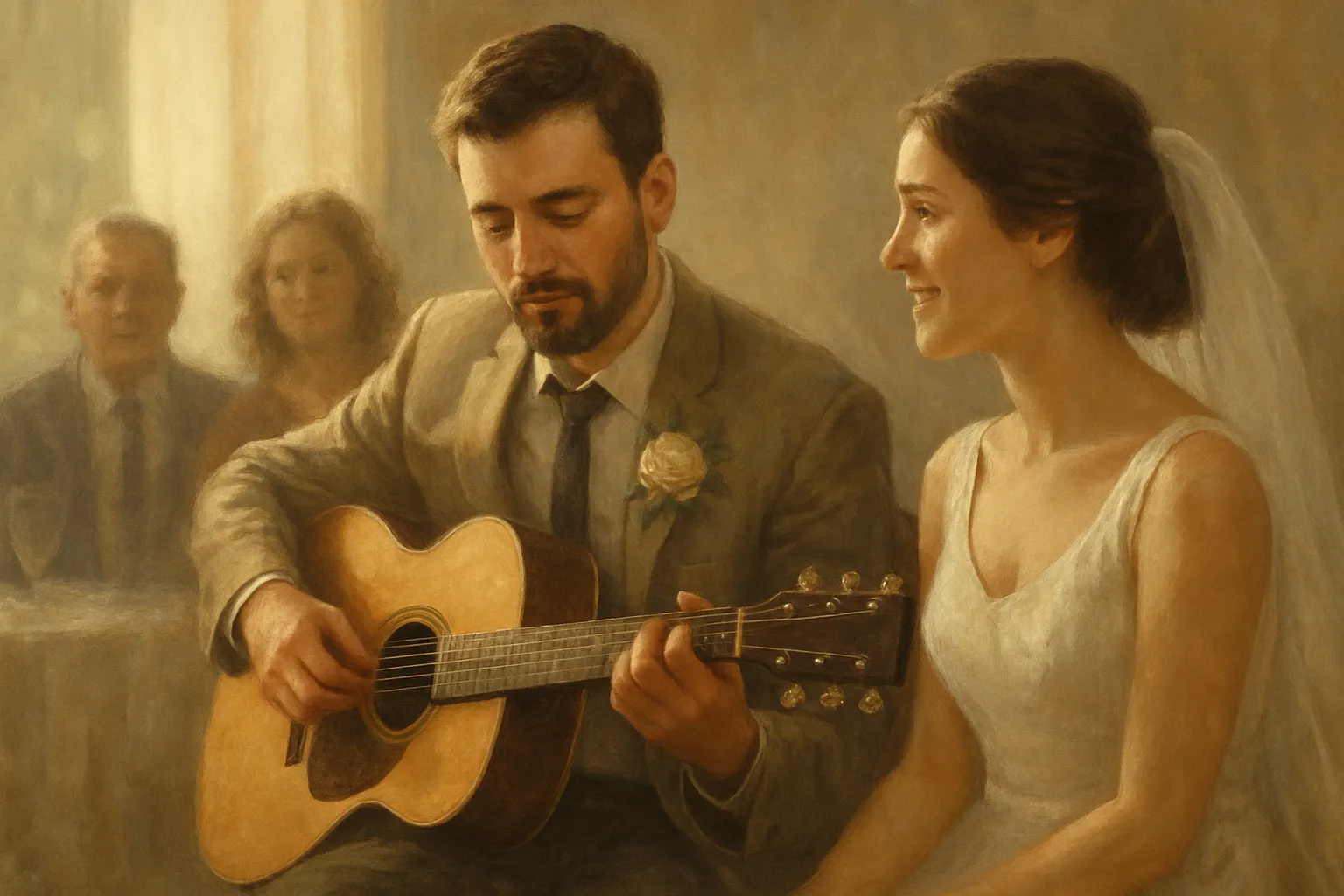
Nervous About Speaking? Replace Your Wedding Speech With a Song
By Anzhelika Eliseeva — Songwriter on the Songive team
Updated 8 min readGuides
A song can stand in for a toast when the speaker dreads the microphone, or when the couple would rather feel something than sit through it. The trick is the brief. Below, a weak one next to a strong one, and why the difference matters.
Listen to this article
A wedding speech alternative song is a short custom track played in place of a spoken toast, built from real details about the couple. It does the job a speech does — naming the people, marking the day, saying the thing out loud — but carries it on a melody instead of nerves and a folded sheet of paper. The short answer to whether a song can replace a speech is yes, sometimes. The longer answer is the rest of this piece.
What a wedding speech alternative song is: a one-verse, one-chorus song written about the couple and played at the reception instead of, or alongside, a spoken toast. It says the same things a speech would — the names, the story, the wish for them — in a form that doesn't depend on you holding it together at a microphone.
When it actually works
We've seen this land beautifully and we've seen it land flat. The difference is rarely the song. It's whether the moment was right for one.
It works when the speaker dreads public speaking. Some people would sooner walk over coals than stand in front of a hundred guests with a glass shaking in their hand. A song carries the message for them. They press play, they sit back down, and the room hears everything they wanted to say without watching them sweat through it.
It works when the recipient is the type who'd rather hear something made than sit through a toast. A bride who tears up at songs but glazes over during speeches. A groom who'd be mortified by a long anecdote but moved by a chorus with his name in it. You know which one the couple is.
It works when the day already has enough talking. Three speeches in, the room is warm, the food is settling, and a fourth person standing up is a slog. A ninety-second song after the meal is a turn in the weather. It resets the room without adding to the queue at the lectern.
A weak brief, and why it falls down
Most songs that disappoint started as briefs that could have been about anyone. Here is the kind we mean.
«Make a song for my best friend Tom's wedding. He's a great guy, really kind and funny, and he deserves the best. He's marrying Sarah and they're perfect for each other. We've been friends for years and I love him like a brother. Make it emotional and happy.»
There's nothing wrong with any of that, and there's nothing in it we can use. «Great guy», «kind and funny», «perfect for each other» — every wedding has those. The song that comes back will be true and forgettable, because it could be sung at the next reception over without changing a word. A toast built from this brief would be just as thin. The form isn't the problem. The detail is.
A strong brief, and what we'd pull from it
Now the same friendship, written down so we can actually see it.
«For Tom and Sarah's wedding, 12 July. I met Tom in the queue for a delayed train to Manchester in 2014 and we ended up sharing a taxi and a pint instead. He proposed to Sarah on that same platform last year — got the announcer to read it out. Tom calls everyone «pal», cries at adverts, can't cook anything but a perfect fry-up. He told me once that Sarah was the first person who made being still feel like enough. Warm, a bit cheeky, not soppy. Play it after the meal.»
We can build the whole thing from that. The train platform threads the start and the proposal together. «The first person who made being still feel like enough» is the chorus, more or less written. «Pal» and the fry-up keep it cheeky so it doesn't tip into sentiment. «Play it after the meal» tells us the length and the energy. This is the difference between a wedding song made for one couple and a card that rhymes.
The anniversary song in the player above came from a brief like the second one — a specific morning, a specific phrase one of them always says. That's why it sounds like them and not like a template.
How you get one, from your side
The part that surprises people is how little you have to do. You're not writing the song. You're describing the people.
First, you write a short note about the couple — the kind of detail in the strong brief above. A few honest lines beat a polished paragraph. You can do this at the song page in about the time it takes to text the best man.
Then you get the lyrics back to read before anything is sung. This is your safety check. If a line lands wrong, or you'd rather lead with the proposal than the train, you say so and it's changed. Nothing reaches the reception that you haven't already approved.
Then you get the finished song as a link you can play from a phone through the venue's speakers, or hand to the DJ in advance. One verse and one chorus is plenty for a room — long enough to land, short enough that nobody checks their watch.
Song, toast, or something in between
A song isn't always the right call, and it's worth being honest about the trade-offs before you commit.
| Option | Best when | Risk |
|---|---|---|
| Songive personalized song | Speaker is anxious, or the couple feels more than they listen | Needs a clear brief and a quick sound-check |
| Spoken toast | You're comfortable at a mic and the story is yours to tell live | Nerves, length, the fourth-speech slump |
| Cover of «their song» | The couple has a clear anthem and you can sing | It's the artist's words, not theirs — see why a custom song differs from a cover |
| Playlist moment | First dance, background, exits | Says nothing specific about them |
Many of the best receptions we've heard about do both — a short song after the meal, then a couple of brief words. The song carries the feeling; the speaker just has to introduce it. That's a far gentler ask than a five-minute speech.
What to put in the about-them box
Write these four things down and the song almost writes itself.
How they met, in one true scene. Not «they met at university» but «she spilled his coffee in the library café and paid him back with a worse one the next day.» The specific scene is what a melody can hold.
A phrase one of them actually says. The thing the groom repeats at every barbecue, the word the bride uses for everyone she loves. Drop it in the chorus and the room that knows them will gasp.
The line you'd struggle to say out loud. «You're the first person who made me feel like enough.» The reason a song stands in for a speech is that it carries the sentence your voice would crack on.
Where in the day it plays, and the mood. «After the meal, warm but cheeky, not weepy.» That single instruction sets the length, the tempo and the tone — and saves us guessing. If you're also shopping for a Father's Day song for dad this week, the same instinct for one true scene applies.
FAQ
Can a song really replace a wedding speech?▾
Yes, sometimes — when the speaker is anxious, when the couple responds more to feeling than to anecdote, or when the day already has enough talking. It works less well when the audience is expecting a personal story told live and would feel short-changed by a recording. Read the room and the couple before you decide.
Should I tell the couple beforehand?▾
Tell them a song is coming, even if you keep the words a surprise. Weddings run on a tight schedule and the couple, the planner and the DJ all need to know there's a moment to make room for. A song nobody expected can collide with the cake cut or the first dance, and the surprise isn't worth the chaos.
Where in the schedule should it go?▾
After the meal, once the speeches are done, tends to work best. The room is warm and seated, and a short song resets the energy without adding to the queue at the lectern. Clear the exact slot with whoever runs the timeline so it doesn't land on top of another moment.
How long should the song be?▾
One verse and one chorus is enough — roughly ninety seconds to two minutes. That's long enough to name the couple, mark the day and land the feeling, and short enough that nobody starts checking their phone. A song that overstays does the same damage as a speech that won't end.
How do I play it at the venue?▾
You get the finished song as a link you can play from a phone or hand to the DJ ahead of time. Do a quiet sound-check before guests arrive so the volume and the connection are sorted. Having someone introduce it in a sentence — «this is for Tom and Sarah» — helps the room settle into it.