The Ultimate Personalized Song Gift: Your Story in Music
By Daniel Brooks — Writer on the Songive songwriting team.
Updated 8 min readGuides
An original song written for one specific person — from their name and the story you tell us — delivered as a sharable link in under two minutes. What the format is, when it lands, and how it compares to the older alternatives.
Listen to this article
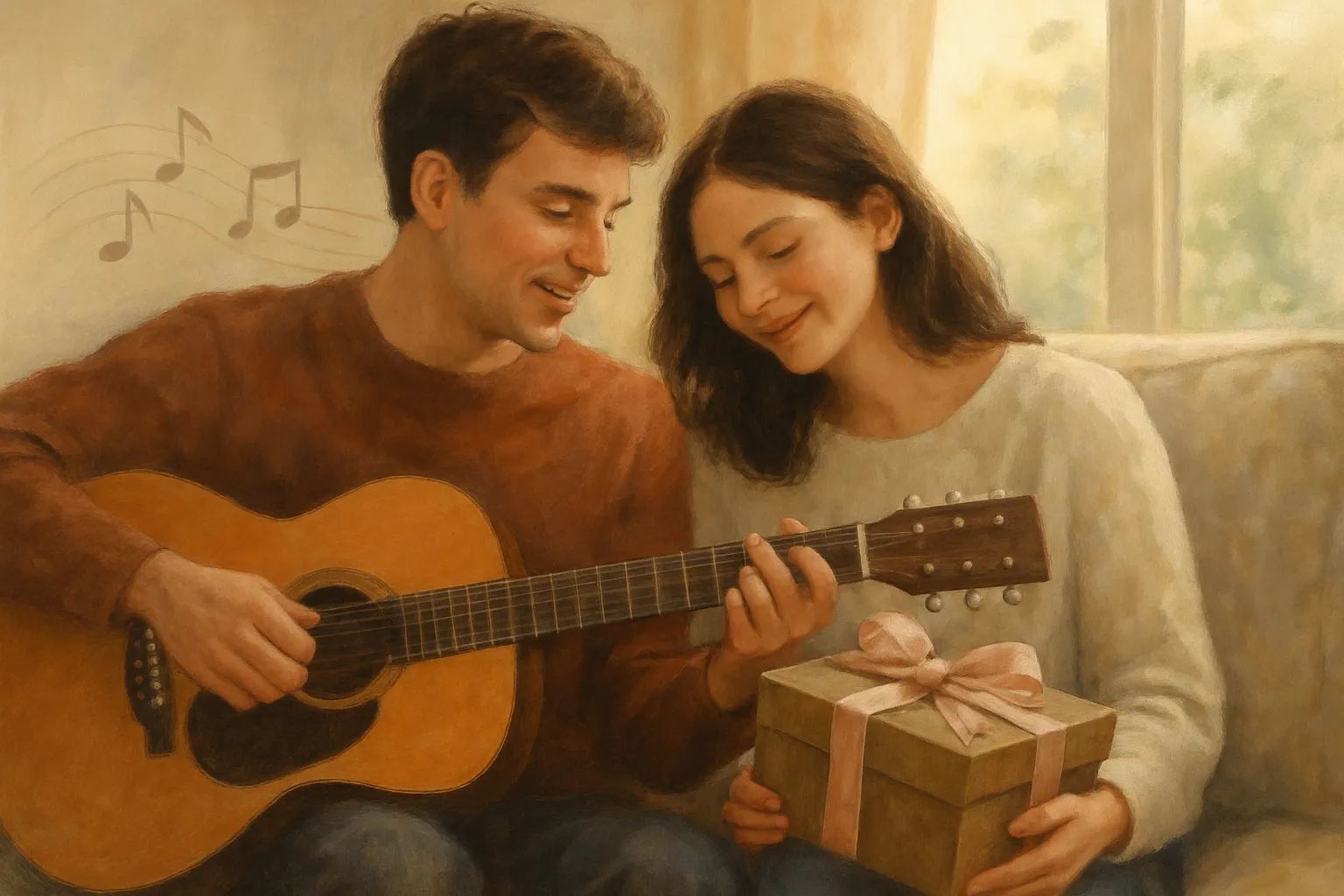
A personalized song gift is an original song written for one specific person — using their name, their story, and details from their life — and delivered as a sharable link. It is not a re-recorded cover of a familiar tune. It is not a generic song with the recipient's name dropped in once. It is a short original song, usually 90 seconds to three minutes, written from a brief the gift-giver fills out, and shared as a link the recipient can open and play. People send them for birthdays, anniversaries, weddings, declarations, thank-yous, apologies, and goodbyes. This guide covers what the format is, when it lands, how it works, and how it compares to the older alternatives.
What a personalized song gift is: an original song, typically 90 seconds to three minutes, written from the recipient's name and a short story about them, and delivered as a sharable link. Distinct from a cover song (an existing song re-recorded), from generic music-creator tools (creator software, not gift-focused), and from a playlist (a selection of someone else's songs).
When people send a personalized song gift
The category covers more occasions than people first assume. The common ones, with the angle that tends to make each one land:
- Birthday. The most-searched use. A song built from one specific habit or memory of the recipient — not a generic "happy birthday." Works for milestone birthdays, long-distance birthdays, or any birthday where flowers feel thin.
- Anniversary. Wedding anniversary, dating anniversary, or any "we've been doing this for X years" marker. The brief writes the song through the shared timeline.
- Wedding. From the bride to the groom (or any pairing). From a parent to a child on their wedding day. From a guest who wants to give something less repeatable than a registry item.
- Mother's Day, Father's Day, parent gratitude. The category where most buyers say afterward "I should have done this sooner." A song addressed to a specific parent, with one specific memory, lands harder than a card with the same words.
- Romantic declaration. A way to say something you can't say in person. Works best when the person being addressed knows you well enough that the specifics in the lyrics read as confession, not performance.
- Apology. Sending a song after a fight or a long silence. The asymmetry of writing a whole song lands as effort in a way a text message can't.
- Goodbye. For a colleague leaving, a friend moving overseas, a teacher retiring. Captures the relationship in a fixed form that travels with the person.
- Thank you. To a teacher, a doctor, a mentor, a friend who showed up during a hard year. The format does what a thank-you note tries to do but in a register most people don't expect.
The pattern across all of these: the format works when there is one specific person and one specific thing you want to say to them. It does not work for generic occasions, large groups, or recipients you barely know.
How a personalized song gift is made
Three steps, in this order, from your side.
The brief. You fill out a short form: recipient name, occasion, relationship, a paragraph about the recipient, a genre, a mood, a voice type, an era, a tempo. The paragraph is the whole game — more on that below.
The lyrics. You receive a verse, chorus, and second verse written from your brief. The recipient's name lands in the chorus. Specifics from the paragraph land in the verses. These are not average pop lyrics with a name swap; they are composed around the story you wrote.
The music. You receive the finished song — a vocal recording that sings the lyrics, with an arrangement that matches the requested genre. The whole song is delivered in under two minutes from form submission.
The result is a single audio file, a recipient-facing page with a "tap to unwrap" animation, and a shareable link. You send the link by message; the recipient opens it; the song plays.
What separates a song that lands from one that falls flat
The difference is almost always the brief.
A name and an occasion alone produce a generic chorus. A name plus a thin sentence — "she's my mom" — produces a verse that could be about anybody's mom. A name plus a specific paragraph — "she's been my mom for thirty-four years and the thing I'll never forget is that she left the porch light on for me at every age, even when I was forty" — produces a verse that reads back like memory. The first line of the song ends up being a paraphrase of that porch light. The recipient hears it and knows the song is for them.
This is the asymmetry in personalized song quality. The song can land in any genre. It can land any name. What it cannot do is invent the specifics. You write the brief; the brief writes the song.
The other thing that separates a landing song from a missed one: matching the genre to the recipient, not to the giver. A song for a dad who only listens to country shouldn't be a synth-pop ballad because the giver loves synth-pop. Match the recipient.
When a personalized song gift works (and when it doesn't)
Works best when the recipient is someone the giver knows well enough to write a specific paragraph about, when the occasion has emotional weight (a milestone, a long-distance moment, a first or last, a reconciliation), when the giver has tried the obvious gifts before and wants something the recipient will save, and when the delivery is digital — a shared link the recipient can replay.
Works less well when the recipient is a casual acquaintance who can't be written about specifically, when the occasion is too formal for a digital gift, or when unexpected musical declarations would be received as a boundary violation.
The format does not replace a handwritten letter or an in-person conversation. It adds something neither one does: it sings the recipient's name back.
Personalized song gifts vs the alternatives
Five categories of gift people typically consider against a personalized song. Honest tradeoffs:
| Option | Time to deliver | Personalization depth | Best for |
|---|---|---|---|
| Personalized song gift (Songive) | Under 2 minutes | High — name + story + genre matched to recipient | A specific person, an emotional occasion, digital-friendly recipient |
| Custom song from a human songwriter (Songfinch and similar) | 5–7 days | High, but constrained by the human's style range | A wedding-tier moment with lead time and budget |
| AI music creator tool (Suno, Udio) | Minutes — but the giver does the work | Whatever the giver puts in | Hobbyists who want to make music for themselves; not gift-first |
| Cover song, playlist, or curated mixtape | Minutes | Low — no personalization beyond track choice | Casual recipients, lower-stakes occasions |
| Handwritten note, card, or letter | Same-day if in-person | High in words, low in form | Recipients who keep physical mementos |
The honest version: most everyday gifts don't need a personalized song. The ones that do are the cases where the giver has been thinking for a week about what to do for someone specific, and the usual options feel flat against what they actually want to say. That is where this format earns its keep.
For common use cases there are specific guides already: an anniversary song for your wife, a custom song with their name in it, or the deeper explainer on how AI music generation actually works.
A short brief — what to put in the "about them" box
The single highest-leverage thing a giver can do is spend three extra minutes on the brief. Suggested structure:
- One specific habit or trait the recipient has — not "she's kind" but "she leaves the porch light on for me at every age."
- One specific memory the giver and recipient share — concrete, dated if possible.
- One thing the giver has never said out loud but wants to.
- The recipient's musical taste in one phrase — "she only listens to Fleetwood Mac" beats "she likes rock."
This paragraph, in roughly that shape, produces songs people save and re-share. Briefs that read like LinkedIn bios produce songs that read like greeting cards. The song is downstream of the input.
Where personalized song gifts are heading
A few directions worth flagging for anyone reading this in late 2026.
Voice control will get more granular. Today, the giver picks a voice type (warm female, deep male, mid-range). Within two years, the giver will be able to upload a reference voice and have the song sung in something close to it. The consent and IP questions there are real and being worked through; Songive's current position is to not enable voice cloning until the consent infrastructure is unambiguous.
Multilingual will become standard. Songive already ships in 13 UI languages with songs generated in the recipient's preferred language. By mid-2027, the market expectation is that any service in this category supports the major world languages by default.
The "AI" qualifier will fade. Right now, "AI song gift" is a search term because the category is new. As personalized songs become a default option alongside flowers and gift cards, people will search "song for my dad's 60th" and skip the AI qualifier. The category will be normal — the way personalized photo books became normal in the 2010s.
Occasion coverage will deepen. The early-adopter occasions are birthday and anniversary. Over the next year, expect more catalog around weddings, graduations, retirements, baby arrivals, and major cultural festivals across markets — Diwali, Lunar New Year, Eid, Hanukkah, Día de los Muertos.
FAQ
What occasions can a personalized song be sent for?▾
Most commonly birthdays, anniversaries, weddings, Mother's Day, Father's Day, romantic declarations, thank-yous, apologies, and goodbyes. The format works for any occasion involving one specific recipient and one specific thing the giver wants to say. It does not work for generic group gifts or recipients the giver doesn't know well.
What's the difference between a personalized song and a cover song?▾
A personalized song is an original song written and recorded specifically for the recipient — their name, their story, their genre. A cover song is an existing song (often a familiar tune like Happy Birthday) re-recorded by a singer. Cover songs don't include the recipient's story; personalized songs are built from it.
How long does a personalized song take to make?▾
At Songive, under two minutes from the time the brief is submitted. Longer at services that use human songwriters — typically 5 to 7 days.
Is it safe to use a friend's name in a personalized song?▾
Yes. The recipient's name is used inside the song's lyrics and on the gift-link page; it isn't sold, shared with advertisers, or used to train anything. Songive's privacy policy describes the data handling in detail, and the company's policy is to never train on user-submitted content.
Can the lyrics be revised if the first version doesn't quite land?▾
Yes. Songive includes a free do-over — if the first song misses, the giver can revise the brief and generate another version. If the second one also misses, the order is refundable. The do-over loop exists specifically because the brief-to-song match is the part that varies most between users.
Will the recipient know it's AI-generated?▾
Probably, if asked. Most recipients in 2026 are familiar with AI-generated media. The question that matters in practice is not "is this AI?" but "is this for me?" — and a song with the recipient's name, their story, and their preferred genre answers the second question regardless of how it was produced.