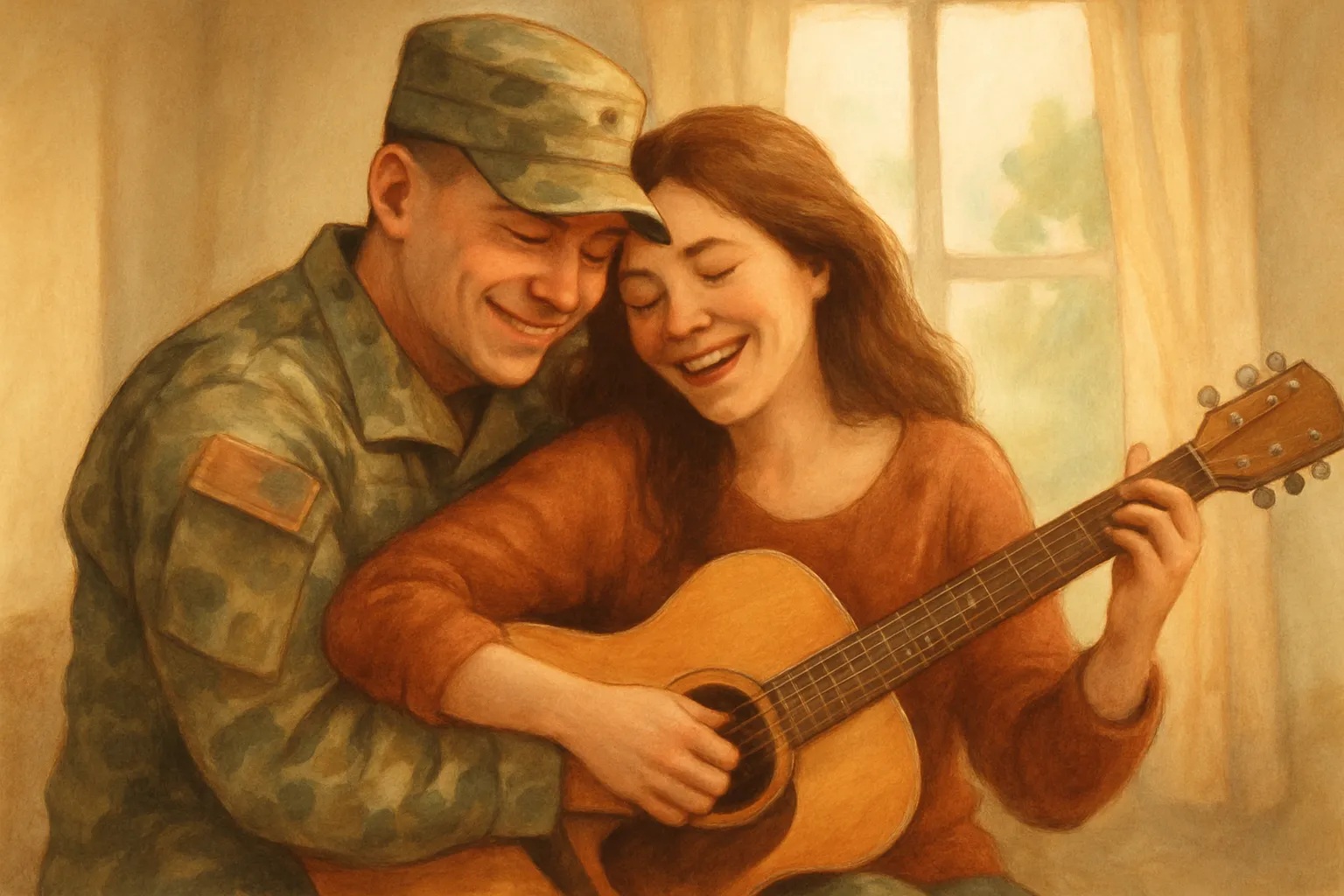
custom song for a soldier's homecoming: the wait, set to music
By Daniel Brooks — Songwriter on the Songive team.
Updated 8 min readOccasions
A custom song for a soldier's homecoming takes their name, the months apart and the first thing you'll say at the gate, and turns it into a track you can play the moment they walk through the door. You write a short brief. You get the words back. The finished song lands in about two minutes.
Listen to this article
A custom song for a soldier's homecoming is a personalised track written about one returning service member — their name, the length of the deployment, the people who waited and the moment of reunion — made to be played when they walk back into the room. You send a few lines about them. The finished song arrives in about two minutes, ready for the airport, the driveway or the kitchen table.
What it is: A song written from the ground up for one homecoming. Not a card, not a playlist, not a cover of someone else's tune. Their name in the chorus, your story in the verses, delivered as a track you can play out loud the second they're home.
When a homecoming brief lands on our desk, the first thing we look for is the gap — what those months felt like from the side that stayed. The best of these songs aren't about the uniform. They're about the small stuff that piled up while they were away: the dog that learned a new trick, the baby who started walking, the empty chair at Sunday dinner. That's what makes the room go quiet when the song plays.
When does a homecoming song fit?
A homecoming song fits any moment when someone comes back after a long stretch away, and it's most powerful when the reunion has a fixed time and place. Here are the scenarios we see most.
- The gate arrival. They land after a long deployment and you're waiting in Arrivals with a sign. Play the song from your phone as they walk out. Their name comes up in the first chorus, and the whole crowd around you clocks that this one is for the person hugging you.
- The surprise on the doorstep. They've told everyone not to make a fuss, so nobody's meant to know the date. The song is queued and ready when the taxi pulls up. It says the things you'd never manage to get out at the door.
- The first Sunday roast back. Nothing dramatic, just the family round the table again after months of a video call propped against the gravy. You play it once everyone's sat down, and the chair that was empty last week suddenly isn't.
- The partner who ran the house alone. A homecoming is also a thank-you to whoever held everything together — school runs, bills, the broken boiler. A song can point the spotlight at them for a change, not just the person coming home.
- The child's welcome. A son or daughter who counted sleeps on a calendar and taped a photo to the fridge. Their voice, their name, their little countdown, written into a verse the returning parent can keep forever.
- The mate coming back to civvy street. A friend leaving the forces for good, not just a tour. The song marks the end of one chapter and hands them the next, with the in-jokes only your lot would understand.
- The grandparents' relief. A grandson or granddaughter home safe, and the older generation who prayed through every silent stretch. Something they can play on the good speaker and cry to in private afterwards.
- The delayed reunion. The flight got cancelled, the date moved twice, and everyone's nerves are shot. When they finally do arrive, a song makes the anticlimax feel like the event it was always meant to be.
How do you make one?
You make a homecoming song in three steps, and the whole thing takes minutes rather than days. Here's what happens from your side.
One: you write a short brief. Tell us who's coming home, what to call them, how long they've been away and one moment you keep picturing — the sign at the airport, the dog going mad, the first proper cup of tea. You don't need to be a writer. A few honest lines beat a polished paragraph every time. If you want a hand shaping it, our notes on the brief for people who've never written a song walk you through it.
Two: you get the words back. You'll see the lyrics before anything is sung. Read them the way you'd read a letter. If the chorus should say "welcome home, Dad" and not "welcome home, soldier", change it. If there's a private nickname that belongs in there, add it. This is the moment to get their name and your story exactly right.
Three: you get the finished song. Pick a mood — tender and acoustic, or something with a bit of lift for the arrivals hall — and the full track lands in about two minutes. Download it, keep it, play it out loud when the door opens. That thank-you demo above started life as a handful of plain sentences, and you can hear how little it takes to make something that sounds like it was always meant to exist.
How does this compare to the other options?
A custom song sits between the effort of hiring a songwriter and the emptiness of grabbing something off a shelf. Before the table, here's the honest read. A card says the expected thing in your handwriting, which is lovely but limited. A meaningful playlist borrows other people's words and hopes one of them fits. A studio songwriter will write something beautiful but usually needs weeks and a deposit, which is no good if the flight lands Thursday. DIY tools hand you the controls and expect you to know what you're doing. Songive gives you their name in the chorus, your story in the verses and a finished track in about two minutes, in the language you choose. If you're weighing the routes, our piece on a personalised song versus a cover lays out the difference plainly.
| Option | Their name in it | Ready by the flight | Your actual story |
|---|---|---|---|
| Songive custom song | Yes, in the chorus | About two minutes | Yes, from your brief |
| Songfinch | Yes | Days to weeks | Yes |
| Suno (DIY) | If you write it in | Fast, but you steer | Only if you can prompt it |
| A meaningful playlist | No | Instant | Borrowed |
| A handwritten card | Written by hand | Instant | Yes, but no music |
What should you put in the about-them box?
What you put in the box decides whether the song sounds like them or like anyone. Four things carry the most weight.
- What to call them, and by whom. "Corporal" reads very differently from "our Danny". Tell us the name the people at the gate actually use, and who's saying it — a wife, a nan, a seven-year-old. That single choice sets the whole tone.
- How long, and how it felt. "Seven months" is a fact. "Seven months, and the twins learned to swim while he was gone" is a song. Give us one thing that changed at home while they were away, so the return has something to measure against.
- The reunion picture. Name the exact spot — Brize Norton arrivals, the front step, the airbase car park in the rain. We'll write toward that image so the song and the moment line up when you press play.
- The one thing you can't say out loud. Most people freeze at the actual reunion. Hand us the sentence you'll never manage to get out — the worry you kept quiet, the pride you don't know how to voice — and let the song carry it for you.
When you're ready to write yours, the song builder takes the brief and turns it around while you're still deciding what to wear to the airport.
FAQ
How quickly can I get a homecoming song?▾
The finished track arrives in about two minutes once you've approved the words. That means you can write it the morning of the arrival, or even in the car park while you wait, and still have it ready before they walk out.
Can I put their military rank or a family nickname in the song?▾
Yes, and you choose which. You'll see the lyrics before anything is sung, so you can swap "Sergeant" for "Dad" or add the name only your family uses. That approval step is exactly where you make the song sound like your person and no one else's.
What if I'm not good with words?▾
You don't need to be. A few plain, honest lines about who's coming home and one moment you keep picturing are enough to work from. Simple beats polished here, because the real detail is what makes the room go quiet.
Can the song be a thank-you to the person who stayed behind, not the soldier?▾
Absolutely. Homecoming is a two-sided event, and plenty of songs we make point the spotlight at the partner who ran the house, did the school runs and held everything together. Just tell us in the brief who the song is really for.
Can I choose the mood and style?▾
Yes. Pick something tender and acoustic for a quiet doorstep moment, or something with lift for a busy arrivals hall. You set the mood before the track is made, so it matches the room you'll play it in.