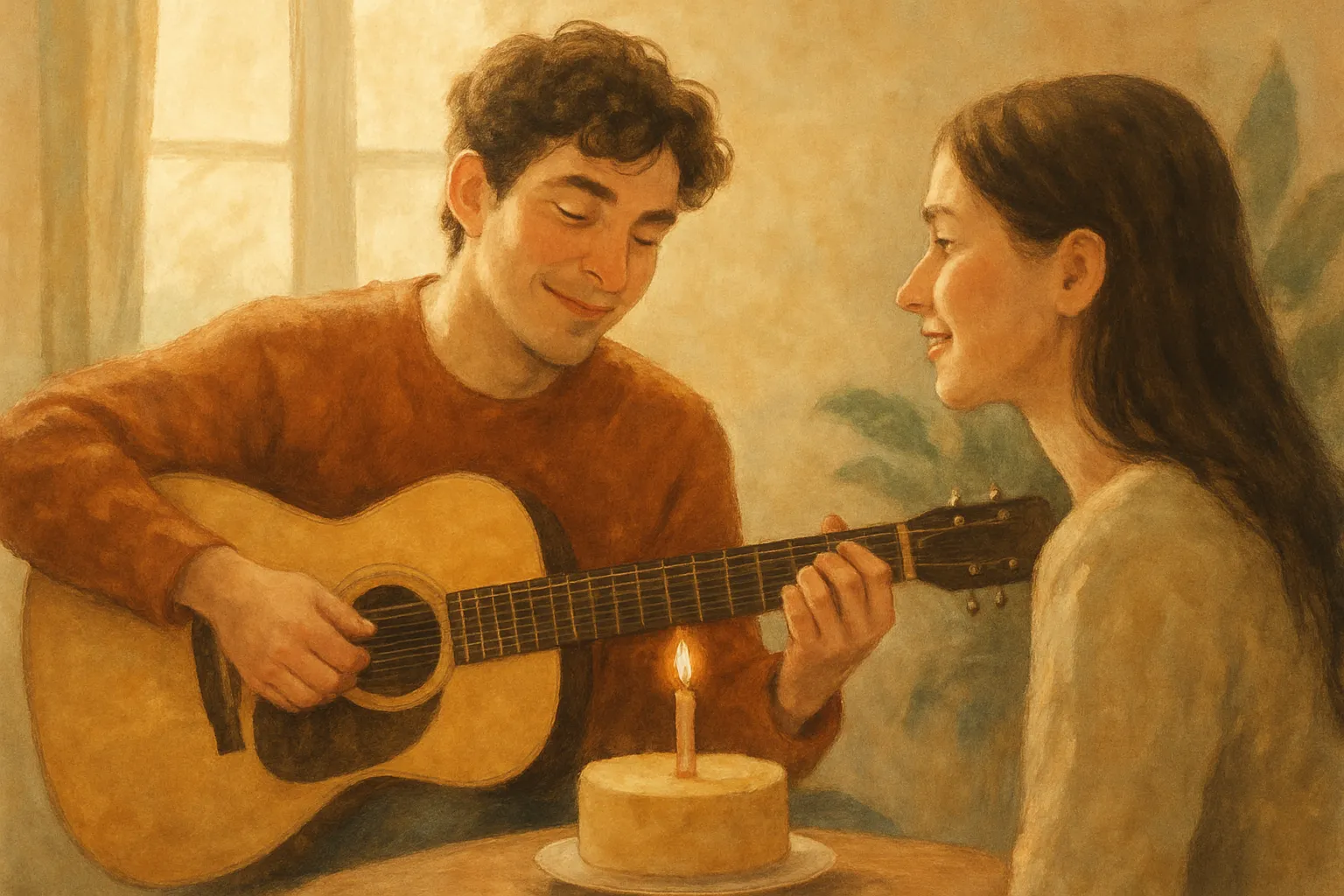
how to write a personalized birthday song that doesn't sound generic
By Sam Hartley — Songwriter on the Songive team
Updated 8 min readGuides
A generic birthday song is a card set to music. A specific one names a habit, a memory, and a wish the person hasn't heard before. The gap between the two is usually three sentences.
Listen to this article
To write a personalized birthday song that doesn't sound generic, you replace three empty phrases with three true ones: one habit only the recipient has, one memory only the two of you share, and one wish they haven't already heard a hundred times. That's the whole method. Everything else — the melody, the arrangement, the name landing in the chorus — is downstream of those three lines.
What a personalized birthday song is: a short original song written about one particular person, using details from their life, delivered as a finished track. Not a rewritten cover, not a card read aloud — a new song that could only have been written about them.
We've made a lot of these. The ones that miss almost always miss the same way. So this piece is a comparison — not of services, but of the two versions of your own brief. The vague one you'd write on instinct, and the specific one that actually turns into a song worth keeping. We'll walk three rewrites and show you exactly where the difference lives.
Why most birthday songs sound the same
The trap is a sentence you already know by heart: "Happy birthday, you're the best, hope you have a great year." It's warm. It's also true of roughly everyone. A song built from it describes a category — a good friend, a lovely mum, a solid mate — never a person.
Generic birthday lyrics fail because they're interchangeable. Swap the name and the song fits someone else completely. The fix isn't more feeling or bigger words. It's smaller, truer facts. The birthday one in the player above started from a daughter telling us her dad reads the last page of every book first — one odd habit, and suddenly the song could belong to no one else.
Here's the pattern we look for in every brief:
- One habit — something the person does that a stranger wouldn't know.
- One memory — a moment the two of you were both there for.
- One wish — what you actually hope for them, phrased plainly, not as a greeting-card line.
Three brief rewrites: vague versus specific
Below are three briefs people sent us, in their first draft, then rewritten with the same three-part habit. Read the pairs. The distance between them is the whole article.
Rewrite one — a friend turning thirty
Before: "It's for my best mate Tom. He's turning thirty. He's the funniest person I know and always there for me. I want it to be upbeat and fun."
After: "For Tom, turning thirty. Habit: he answers the phone "go on then" before you've said a word. Memory: we got the last train wrong out of Leeds in 2019 and walked two hours home in the rain arguing about chips. Wish: that he finally believes he's allowed to want the bigger job."
The before could be any Tom. The after has a phone greeting we can put in a verse, a rain-soaked night we can build a chorus around, and a real hope to close on. "Funniest person I know" tells us nothing we can sing. "Go on then" is a lyric.
Rewrite two — a partner's birthday
Before: "For my girlfriend Aisha. She's beautiful, kind, and my whole world. Make it romantic and heartfelt."
After: "For Aisha. Habit: she narrates the dog's inner thoughts in a posh voice on every walk. Memory: our first flat had no heating, so we watched films in coats and called it camping. Wish: that this is the year she puts her own name on the studio door."
"My whole world" is heartfelt and completely blank. The posh dog voice, the cold flat you renamed rather than complained about — those are the things that make Aisha laugh when she hears them, because she'd forgotten she does them. That's the reaction we're building toward.
Rewrite three — a parent's birthday
Before: "For my mum's 60th. She sacrificed so much for us and deserves the world. Something emotional that shows how grateful we are."
After: "For Mum's 60th. Habit: she keeps a biscuit tin that has never once held biscuits — buttons, spare keys, a broken watch. Memory: she drove four hours in one go to bring me a forgotten passport and refused to admit she'd sped. Wish: that she stops apologising for taking up space."
Gratitude is the feeling; the biscuit tin is how you prove it. The passport dash shows the love without the word "sacrifice." A song made from the after version is one your mum plays again. The before version is a card she'll put in a drawer. If you want more on this, we wrote a fuller guide to a personalized song for mom and a birthday song with their name in it.
Where each approach lands
Before you decide how to make the song, it helps to see the honest trade-offs. A greeting card is fast but silent on detail. A rewritten cover borrows a melody everyone already associates with someone else. A generic online generator will happily accept "you're the best" and hand back exactly that. A songwriting service like Songive turns your three specifics into a finished, named track — the difference is what you put in, and what you're willing to say. See how a personalized song compares to a cover if that choice is live for you.
| Approach | Uses your specifics | Original to the person | Name in the chorus | Turnaround |
|---|---|---|---|---|
| Greeting card | A line, hand-written | No | No | Immediate |
| Rewritten cover | Sometimes | No — borrowed melody | Rarely | Slow |
| Generic generator | Only if you insist | Weak | Occasionally | Fast |
| Songfinch | Yes, via brief | Yes | Yes | Days to weeks |
| Songive | Yes, built around them | Yes | Yes, in many languages | Minutes |
None of these are wrong. But a song only escapes "generic" if the input does. The service can't invent the biscuit tin — you have to hand it over.
What to put in the about-them box
- The habit nobody else would notice. Not "she's kind" — "she texts "landed safe" the second the wheels touch down, every flight." A small ritual beats a big adjective every time.
- The memory you both carry. Name the place, the year, the weather if you remember it. "The night we missed the last bus from the coast and slept in the car" is a verse. "We've had good times" is nothing.
- The wish they haven't heard. Skip "have a great year." Try what you actually hope: "that you stop shrinking your plans to fit other people's comfort." Specific hopes make listeners go quiet.
- The tone and their name, spelled the way they use it. Tell us whether it should be playful or steady, and give the name exactly — "Sam, never Samuel." You can shape all of this when you start a brief.
The rule underneath all four: if the detail could be true of someone else, cut it or make it sharper. A birthday song stops sounding generic the moment it could only be about one person.
FAQ
What makes a birthday song sound generic?▾
Interchangeable praise makes it generic — "you're the best, hope you have a great year" fits everyone. If you can swap the name and the song still works for a different person, it's generic. Specific habits, shared memories and plain wishes are what fix it.
How do I write a personalized birthday song if I'm not a songwriter?▾
You don't need to write lyrics — you supply the truth and a service shapes it. Give one habit, one memory and one wish about the person, spell their name the way they use it, and pick a tone. The song is built from those specifics.
How many details should I include in the brief?▾
Three strong ones beat ten weak ones. One habit, one memory and one wish is usually enough to make a song unmistakably theirs. Add more only if each new detail is equally concrete; vague extras dilute the good ones.
Can I put the person's name in the chorus?▾
Yes, and it's one of the details that makes the song feel made for them. Spell it exactly as they use it — "Sam, never Samuel" — so the line lands right. Songive can place the name in the chorus in many languages.
How fast can I get a personalized birthday song?▾
Songive turns a brief into a finished track in minutes, which suits a birthday that arrived faster than your planning did. A cover or a bespoke session-written song takes days or weeks. The quality still depends on the specifics you provide, not the speed.