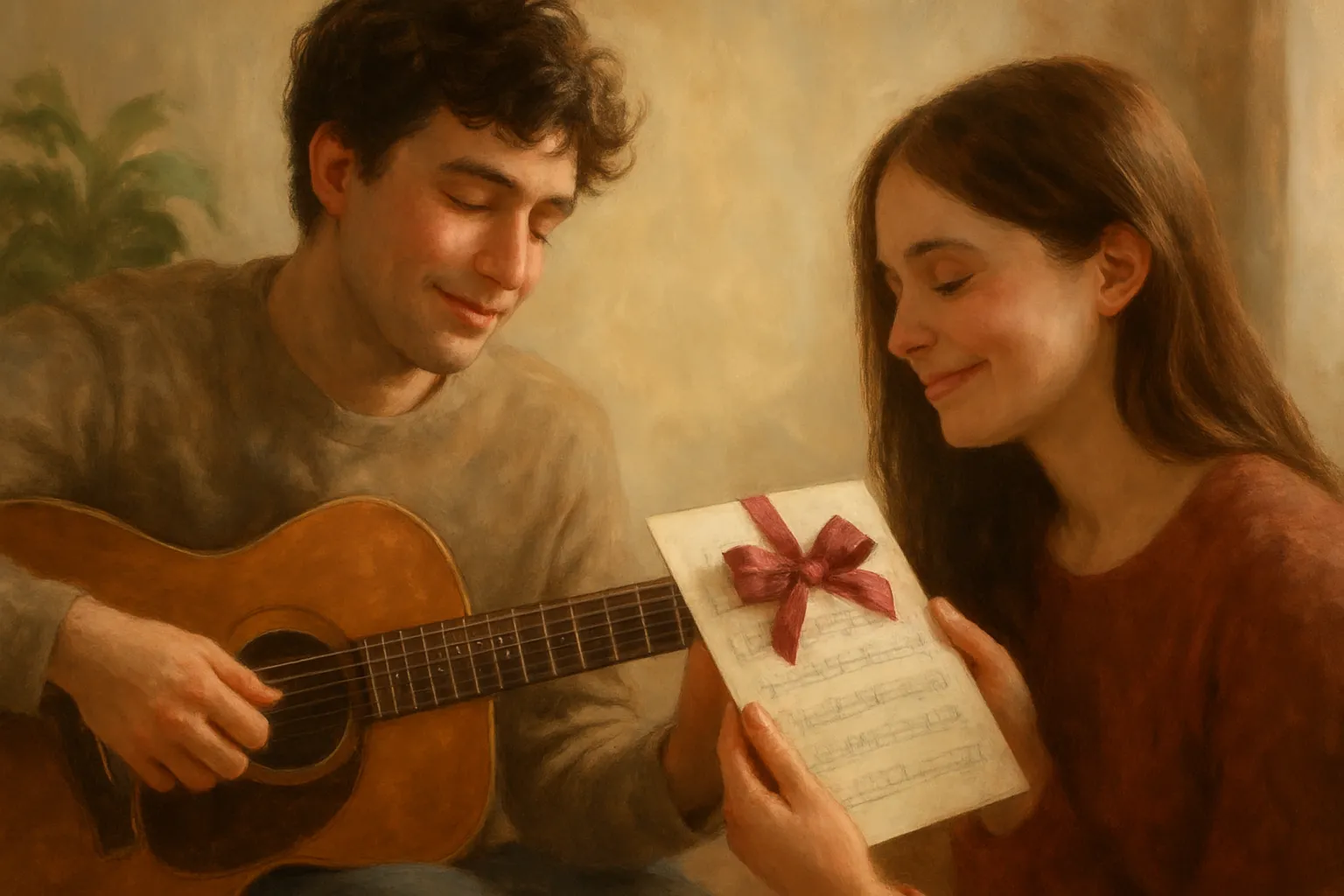
Are Personalized Songs Legal as Gifts? What You Need to Know
By Daniel Brooks — Writer on the Songive songwriting team.
Updated 8 min readGuides
A personalized song you bought as a gift is yours to give, play and share with the person it was made for. The short version: yes, it is legal. The longer version has a few edges worth knowing before you hit post.
Listen to this article
A personalized song you bought as a gift is legal to give, play and share, because you commissioned an original work written about a specific person and received the rights to use it for personal purposes. It is not a cover, it borrows no existing recording, and it carries no third-party samples. You ordered something new. That is the cleanest possible footing for a gift, and it is why a made-to-order song sits comfortably where a karaoke clip or a borrowed track does not.
What a personalized song is: an original piece of music written from a short brief about one person — their name, their story, the occasion — and produced as a finished track you can keep. It is made for you, not licensed from a catalogue, so giving it away is the whole point.
Occasions where the legal question actually comes up
Most people never think about rights until they want to share the song. Here is where the question tends to surface.
- The wedding first dance. You commission a song for the couple and the venue plays it over the speakers. With an original work made for that day, there is no catalogue licence to chase and no performing-rights worry — anniversary season opens this week, and this is the most common moment people ask.
- The 40th birthday slideshow at a rented hall. You set photos to the song and play it for fifty guests. Because the music was written for the honoree rather than pulled from a streaming service, a private event plays it without the usual public-performance headache.
- The Instagram post for your partner's anniversary. You want the chorus with their name on your grid. A song made for you can be posted to a personal account as a gift — the edge appears only when a track sits under monetised or branded content.
- The memorial gathering for a grandparent. You play a song built from the family's stories at a small service. Original work made for that family carries none of the clearance problems a famous recording would bring to the same room.
- The long-distance friend who moved abroad. You send the file directly so they can keep it forever. Sharing the actual song with the person it was written for is exactly what you bought, on any continent.
- The retirement send-off at the office. You play it in the break room for a colleague's last day. A private workplace gathering is fine; the question only sharpens if a company wants the song inside an advertisement.
- The new-baby announcement video. You score a short clip with a song about the baby's name and share it with relatives. Personal family sharing is squarely within what a commissioned gift covers.
- The proposal you film and want to keep private. You play the song, record the moment, and never post it. This is the simplest case of all — a private gift, kept private, raises no question whatsoever.
How you get the song, and what you actually receive
Step one — you write a short brief about the person. You answer a few plain questions: their name, the occasion, one or two stories that only the two of you would know, the mood you want. For an anniversary you might write "twelve years, they still hum off-key in the kitchen." That paragraph is all the raw material the song needs.
Step two — you get the lyrics to read first. Before anything is finished, you see the words written about the person. You can check that the spelling of their name is right and that the memory you mentioned landed the way you meant it. If the second verse misses, you say so and it changes. Nothing is locked until you are happy.
Step three — you receive the finished song. A complete track arrives, usually the same day, with the name in the chorus and the story in the verses. You download it, you keep it, and you do what gifts are for — you give it to the one person it was written about. You can start a brief on the song creation page and see the whole flow before you commit.
Where a personalized song sits next to other options
The legal comfort of a gift depends on where the music came from. A cover recording of a famous song carries the original songwriter's rights, which is why posting one publicly can draw a takedown. A public playlist you assemble is borrowed catalogue music — lovely to listen to, but not yours to give. A handwritten lyric on paper is wholly yours but never becomes a playable track. A song commissioned for one person is the rare case that is both original and yours to share. The table below sets the everyday gift options side by side so you can see which ones travel well from a private moment onto a public feed.
| Option | Original work | Yours to share with the recipient | Safe to post publicly | Name in the song |
|---|---|---|---|---|
| Songive personalized song | Yes | Yes | Generally, for personal use | Yes, in the chorus |
| Songfinch personalized song | Yes | Yes | Generally, for personal use | Yes |
| Suno track you generate | Yes | Yes | Depends on terms | If you write it in |
| Cover of a famous song | No | Limited | Often risky | No |
| Public playlist | No | No | No | No |
What to put in the about-them box
- Their full name and how it sounds out loud. Write the name exactly as you say it, and flag any unusual spelling. "Siobhan, pronounced shiv-awn" tells the lyrics how to land the chorus, and it spares the recipient the small sting of hearing their own name wrong.
- One private memory, not a résumé. Skip the list of accomplishments and give one specific scene. "The night the car broke down outside Marfa and we laughed instead of panicking" carries more weight than "we love to travel," because the song can build a verse around it.
- The occasion and the relationship. Say whether this is an anniversary, a retirement, a goodbye, and who is giving it to whom. A song from a daughter to a mother reads differently from one between partners — see our note on personalized songs for mom for that distinction.
- The mood you want them to feel. Tell us whether you want them grinning or quietly teary. "Warm and a little nostalgic, not a tear-jerker" steers the whole arrangement, and it is the single most useful line you can add. If you are unsure, the guide to what a personalized song is walks through the choices.
FAQ
Who owns a personalized song I bought as a gift?▾
You own the right to use the song you commissioned for personal purposes — giving it, playing it and sharing it with the recipient. It was made to order for you, not licensed from a catalogue, which is what makes it cleanly giftable. For any commercial or advertising use, check the terms before you build a campaign around it.
Can I post the song on Instagram or TikTok?▾
Yes, for a personal post sharing the gift, an original song made for you is the safest kind of music to put on your feed. Because it borrows no existing recording, it avoids the takedowns that catch people who post covers. The grey area is monetised or branded content, where you should review the usage terms first.
Is it different from posting a cover of a famous song?▾
Yes, and the difference matters. A cover carries the original songwriter's rights, which is why public covers often get flagged or removed. A song written from scratch about your recipient has no third-party catalogue behind it, so it travels onto a personal feed far more comfortably.
Does it change if the recipient is a public figure?▾
It can, so be more careful here. A private gift to anyone is fine, but publishing a song that names a celebrity or politician can raise publicity and likeness questions depending on how it is framed. Keep a song about a public figure to private sharing unless you have cleared the public use.
Can I play the song at a wedding or public event?▾
Yes, at a private celebration like a wedding or birthday you can play the commissioned song without the usual licensing worry. Because it is original work made for the occasion rather than catalogue music, the public-performance complications that follow famous recordings simply do not apply in the same way.